Set Up an EMI/ PSP Company in the Netherlands
Here is a guide on how to obtain an EMI/ PSP license in the Netherlands. Contact us if you want to register a company in the Netherlands in this sector.

Electronic money institutions (EMIs) are companies that issue electronic money, while payment institutions (PSPs) provide payment services without issuing electronic money; both that can be used for various purposes in the Netherlands. To open such a business, it is necessary to complete several steps, among which the most important is the licensing one. The procedures of incorporation and obtaining the license can be followed with the help of our agents for starting a company in the Netherlands.
Requirements to set up an EMI/ PSP company in the Netherlands
To obtain the license for issuing electronic money, investors must first incorporate a PSP company in the Netherlands. For this, they need to ensure:
- a Dutch address;
- a minimum initial capital of EUR 350,000 for an EMI (EUR 20,000-125,000 for a payment institution, depending on the services);
- adequate management in the form of directors who have expertise and experience in the financial sector.
Apart from these considerations, the registration with the Companies Register is done following the Company Law. You can rely on our local specialists during the procedure for setting up a company in the Netherlands in this field.
Steps to obtain an EMI license in the Netherlands
When opening a PSP company in the Netherlands, one must apply for a special license with the Dutch National Bank (DNB). The steps to obtain it imply:
- drafting a solid business plan;
- preparing detailed documents regarding client protection, governance, and risk management, and security incident measures;
- creating the Anti-Money Laundering regulations;
- submitting the file to the National Bank.
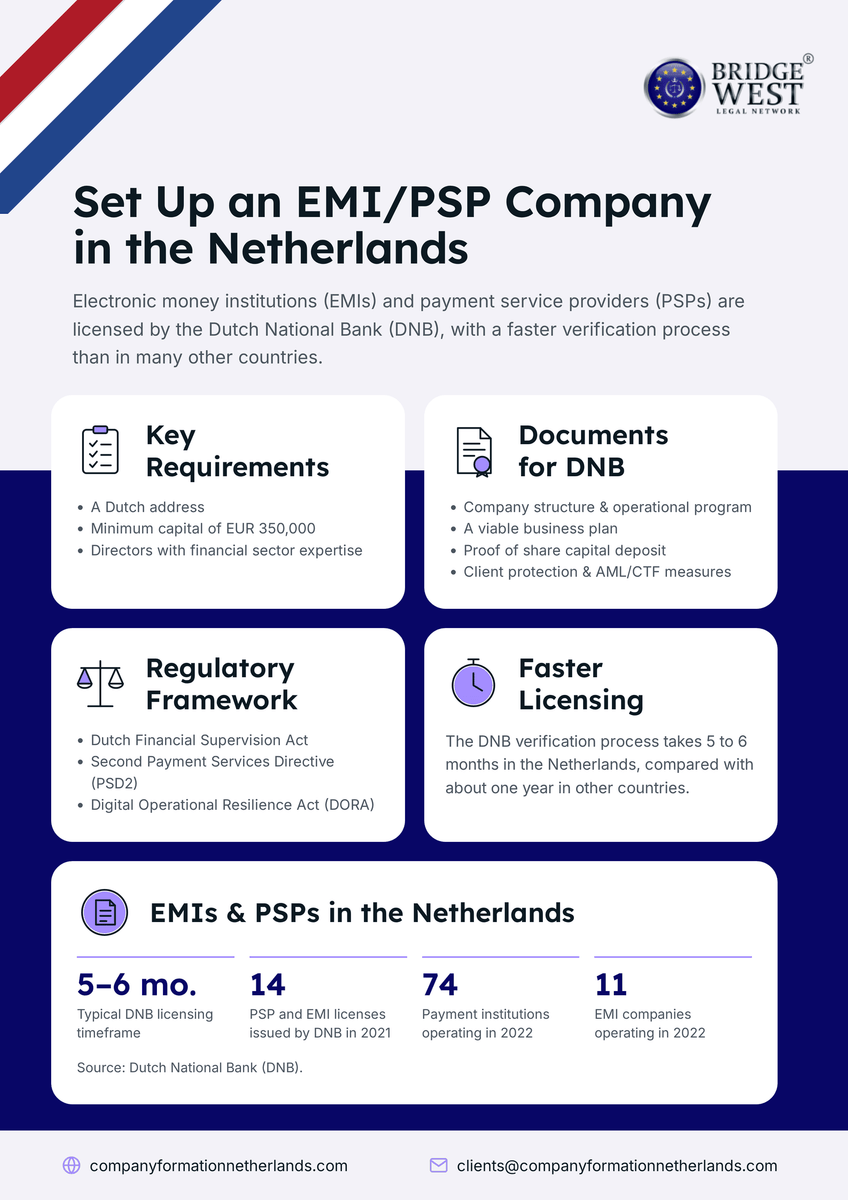
An advantage of opening a Dutch EMI company is the reduced verification timeframe from the DNB. While in other countries, the procedures take about one year to complete and the license to be issued, the same process can take between 5 and 6 months in the Netherlands.
The PSP application procedure
The Dutch PSP license application requires providing the following information to the National Bank:
- company details (structure, shareholders, and directors’ information);
- an operational program where the activities of the business are described;
- a business plan, which must prove the viability of the company;
- proof of depositing the share capital;
- the measures to protect clients;
- the government and compliance regulations;
- information on how complaints will be monitored and security accidents addressed;
- details on how payment information will be managed to prevent data breaches;
- AML and Counter-Terrorism Financing (CTF) regulations.
Our company formation consultants in the Netherlands can assist with the gathering and filing of the necessary documents when opening an EMI company and filing for a PSP license.
Regulations PSP companies must respect in the Netherlands
While the Dutch National Bank is the main institution that supervises the activities of EMI companies, such businesses can also obtain passporting rights and offer their services in other EU countries. As such, they must respect:
- the Dutch Financial Supervision Act;
- the Second Payment Services Directive (PSD2);
- the European Digital Operational Resilience Act (DORA).
In accordance with the last 2 legal frameworks, Dutch PSP companies must also adhere to the European Central Bank regulations.
How many electronic payment institutions operate in the Netherlands?
Most EMI companies in the Netherlands issue digital coins in the form of gift cards or electronic wrist bands, according to the DNB. In terms of the number of such businesses:
- in 2021, the Bank issued 14 PSP and EMI licenses in the Netherlands;
- at the level of 2022, there were 74 payment institutions and 11 EMI companies operating in the country.
If you want to set up an EMI/ PSP company in the Netherlands and need assistance, do not hesitate in contacting us.
Rolf Peter Rothuizen, Attorney at Law · 7 October 2026Rolf Peter specializes in Business Law, Company Law and Tax Optimisation, has an LL.M. in Public, Private and European Law.